
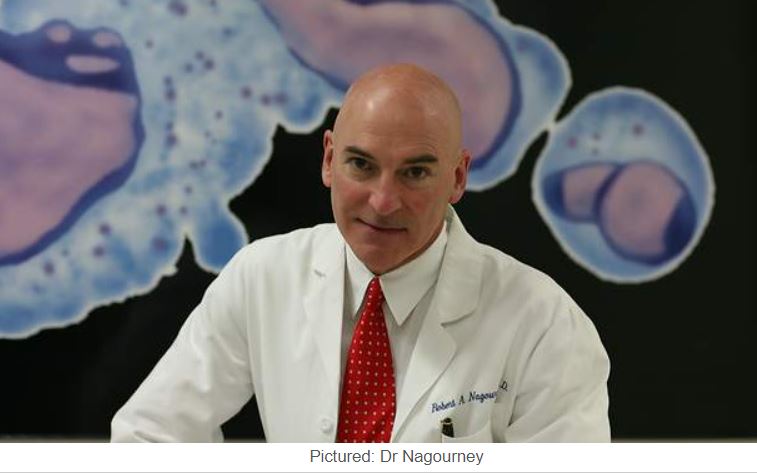
Grace Gawler comments: This article by Dr. Robert A. Nagourney, MD is a reminder of the loss of humanity, compassion, and empathy that can be experienced by patients as they navigate the cancer maze. Unfortunately, I hear this from patients far too often. However, we must also be aware not throw the baby out with the bathwater, there are oncologists who are aware of the needs of the patient beyond their cells. I try to encourage my clients to engage with oncologists who offer more than just treating their cancer. I have known of Robert Nagourney for many decades and had the pleasure of several correspondences with him regarding patients. I have been impressed by his knowledge compassion and care for his clients.
Best Advice: Attempt to encourage a compassionate and partnership approach if you find your oncologist is letting you down with regards to listening and understanding you as a person with cancer and not just cancer cells that need to be eliminated. Sometimes they are caught up in medical systems that prevents them from spending too much time with patients. They too are a stressed profession. It is complicated! Dr Nagourney practises precision diagnostics and personalised cancer medicine which includes – the patient!
What Have Medical Oncologists Lost? Empathy!
Dr. Robert A. Nagourney, MD
Cancer patients approach their diagnosis with a sense of terror. One day they are fine and feeling well and the next, they have a terminal diagnosis. Like Elisabeth Kubler-Ross’ 1969 book, “On Death and Dying” people go through 5 stages of grief: Denial, anger, depression, bargaining and finally acceptance. Every stage is true for the newly diagnosed cancer patient.
What do patients with a new cancer diagnosis seek from their medical oncologist?
Empathy!
They want the doctor to take their problem seriously. They want it to matter. They want to feel that the physician is engaged.
What do they get instead?
Cold, calculated statistics; doom and gloom and disastrous survival expectations all offered with an extra-large helping of expected toxicity. What’s not to like?
Physicians don’t want to become emotionally involved. Doctors cannot expend their limited emotional resources on every patient. A large part of this reflects the oncologists’ own sense of dread.
After all, oncologists who spend their careers doling out “business-as-usual” guideline-driven therapy expect to lose their patients. And they usually do. If the oncologists have already given up, how can they possibly instil a sense of optimism in their patients?
In addition, physicians feel compelled to outline in detail, every possible toxicity. After all, they do not want to be sued for misrepresentation. The more they can layer on the toxicities, the more the patient comes to expect a bad outcome, allowing the physician off the hook.
A patient who does poorly fulfills the academic physician’s predictions, making him smart. While a patient who does better than expected must surmise that it is the physician’s expertise that beat the odds. Thus, taking their physician from smart to brilliant!
The whole game is rigged against the patient, who, from the moment they first speak with their oncologist, go from the realm of the living to join the ranks of the walking dead.
Where did we go wrong? First, we elevated evidence-based medicine to the status of a religion. In fact, there is relatively little evidence available to guide many medical decisions, yet we parade statistics like they are God-given answers to the questions desperate patients are asking.
My practice is very different. I am optimistic. Every patient is their own story in real time. I don’t dwell on doom and gloom. I look toward the possibility of a good outcome.
I use my laboratory to measure likelihoods of benefit. Yes, there are cases where I find no active treatment. Those are difficult discussions but luckily, I have had relatively few of them. And yes, I sometimes recommend a treatment and it doesn’t work. Our tests are not perfect, they are just better.
I am engaged in each patient’s wellbeing. I spend time and energy examining their tumor biology and I am invested in their outcome. I have very good reason to believe that our treatments will work. This isn’t idle speculation but, scientifically founded prediction.
I used the term robotic medicine in a blog to define the way these doctors approach their patients with a cool, calculated, and faux scientific management style.
Physicians should realize that there is relatively little science to much of what they do and that statistical significance is much less significant when applied to individuals and not populations.
Patients do not need more pessimism. There is already plenty of that to go around. What they need is legitimate scientifically based approaches to their individual cancers.
I use that approach and I am immensely gratified to see good outcomes, some of which are so stunning that they might not ever be seen by the average oncologist, academic, or community.
The laboratory analyses that we apply have proven to be able to provide two-fold higher response rates and a statistically significant improvement in survival.
That is what patients want to hear.
Dr. Robert A. Nagourney, MD
Dr. Robert Nagourney has been internationally recognized as a pioneer in cancer research and personalized cancer treatment for over 20 years. He is a TEDX SPEAKER, author of the book OUTLIVING CANCER, a practicing oncologist and triple board certified in Internal Medicine, Medical Oncology and Hematology helping cancer patients from around the world at his Nagourney Cancer Institute in Long Beach, California.
You might also like to explore https://newswire.net/newsroom/pr/00136567-dr-nagourney-cancer-treatment-with-promising-results.html