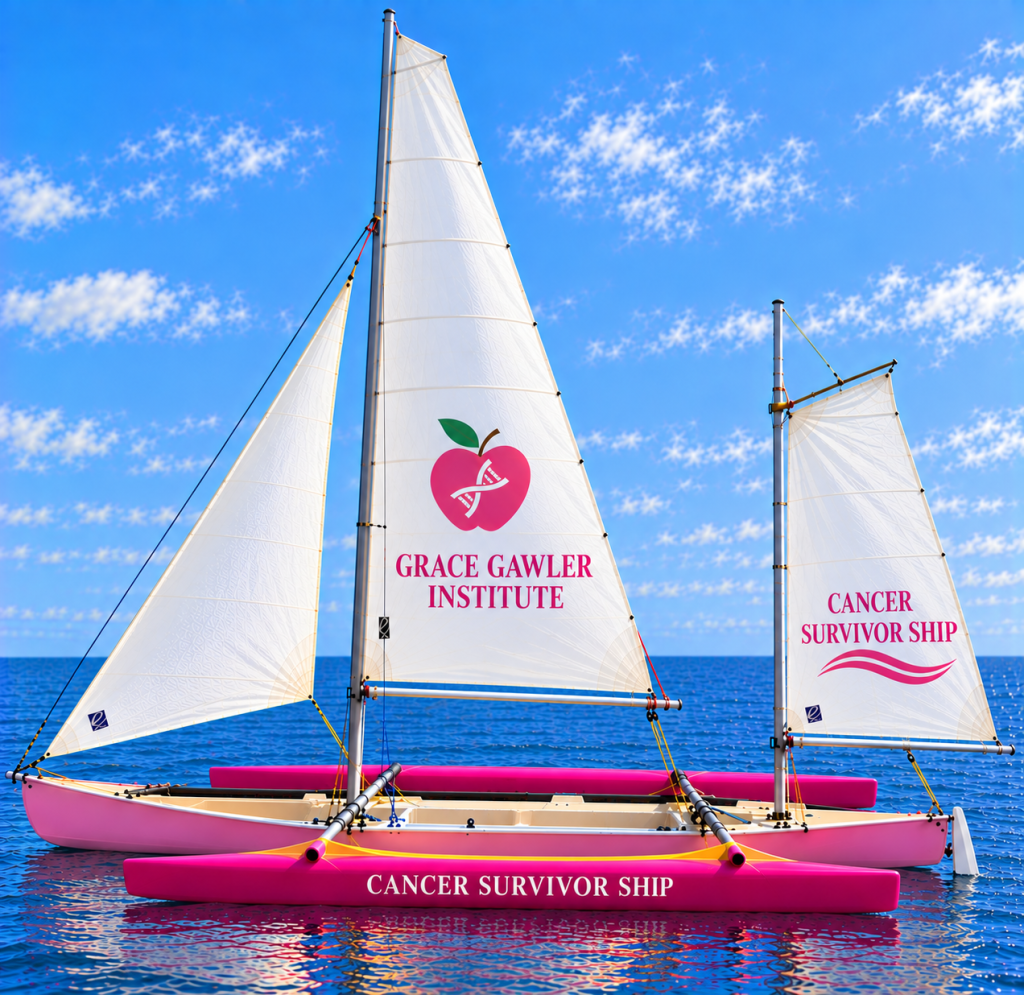
As the project progressed, we moved to the boatbuilders’ premises, where the newly shaped floats were fibreglassed, finished and painted. Eventually, with the canoe and its two bright new floats completed, we added a 2.5-horsepower outboard motor and transported our creation back to the Gold Coast.
There, another local doctor helped me fit the two masts, rudder and other necessary fittings. What had begun as a second-hand canoe was gradually transformed into something quite unique: The Cancer Survivor Ship, a little ship with a very big message.
Putting three sails on an eighteen-foot canoe with outriggers and expecting the whole contraption to sail properly was, to say the least, a little ambitious. We fully expected a fair amount of trial and error, followed by adjustments to the sails, masts, rudder or outriggers.
Remarkably, none were needed.
From its very first sail, the Cancer Survivor Ship performed beautifully. Everything worked as it should, and no final adjustments were required. It was a wonderful testament to the skill, experience and ingenuity of the people who helped us design and build her.
The Cancer Survivor Ship was very much a collaborative effort, created with imagination, goodwill and a great deal of practical know-how. We remain enormously grateful to the two doctors, the engineer and the father-and-son boatbuilding team who helped us turn an unlikely idea into reality.
And, more than a decade later, the little ship with a very big message is preparing for a new life in Tasmania.